 1
1
 842
842
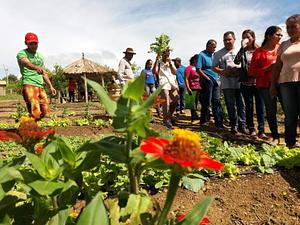
CEDASB - Centro de Convivência e Desenvolvimento Agroecológico do Sudoeste da Bahia
Descripción breve del lugar y las prácticas
Centro de Convivência e Desenvolvimento Agroecológico do Sudoeste da Bahia (CEDASB) is a civil society organisation that works with agroecology and projects for living in the semi-arid region of Bahia. Its activities cover 39 municipalities in Bahia, spread across the Sudoeste Baiano, Médio Sudoeste, Vale do Jequiriçá, Médio Rio das Contas, Sertão Produtivo, Sisal, Bacia do Jacuípe and Piemonte da Diamantina identity territories. These territories are located in the semi-arid region of Bahia, which accounts for more than 80% of the state, where the majority biome is the Caatinga.
These municipalities are part of the "Coexistence with the semi-arid region" programme, with the implementation of low-cost water infrastructure that is easy to replicate, consolidating them as Social Technologies. CEDASB implemented 14,971 rainwater harvesting social technologies, which represent, on average, 59,845 people no longer dependent on others for access to water to maintain their families' lives. Of these families, 2,047 could also benefit from social technologies for collecting water for food production. As part of the total amount, almost 4,500 families are assisted by CEDASB in agroecological technical assistance and rural extension.
Founded in May 2006 the organization focuses on supporting family farmers through the implementation of rainwater harvesting technologies, including cisterns for household consumption (16,000 liters), production cisterns (52,000 liters, such as "calçadão and enxurrada systems"), trench ponds, underground dams, and small retention basins. Additionally, it leads initiatives for Contextualized School Cisterns, Rural Technical Assistance and Extension projects, and programs to rescue and store heirloom seeds, strengthening the Agroecological foundation of local communities.
CEDASB arose in response to a pressing need of family farmers who lacked access to quality water for household use and agricultural production. This challenge led to the development of rainwater harvesting technologies, beginning with cistern construction. The groundwork for this initiative was laid in 1999 by the Pastoral Land Commission (CPT) of the Archdiocese of Vitória da Conquista in collaboration with Catholic parishes, rural workers' unions, community associations, and public and private institutions. This collective effort demonstrated the potential for transformative change, fostering a shared vision of sustainable living and farming practices that harmonize with the realities of the Semi-Arid region.
Through partnerships and collaboration, these organizations enabled the implementation of projects aimed at empowering rural families to thrive in harmony with the Semi-Arid environment. Over time, discussions among stakeholders underscored the need for an entity dedicated to agroecological principles and the continuity of rainwater harvesting technologies. Thus, in May 2006, CEDASB was formally established as a thriving initiative, rooted in the fertile soil of Southwest Bahia and nurtured by the collective dedication of its founders. Today, CEDASB stands as a symbol of resilience and hope, championing a dignified and abundant life in the Semi-Arid region by unlocking its economic, social, and cultural potential through agroecology.
Find out more (in Portuguese)
https://cedasb.org.br/
¿Qué sueñas para el futuro de la granja o del lugar en general?
The dream of CEDASB's team is to create a thriving Semi-Arid region where abundance replaces scarcity, and the land's natural potential is fully realized. CEDASB aspire to see a landscape transformed by agroecology, where healthy soils, heirloom seeds, and community-led initiatives become the backbone of local economies. Beyond economic sustainability, CEDASB vision extends to cultivating a deep connection between people and their land, preserving cultural traditions, and empowering future generations to continue the legacy of care for the environment and collective well-being.
NDVI Monitoring
Ask the admin to Enable NDVI monitoring to this location to get monthly vegetation index images (3 years historical data + automatic monthly updates).